 RollPoll
The guide · Section 7 of 15
Results and the record
The results page, checking the count, the record anyone can recount, the raw data, and scrutineer links.
Where the results are
At the top of the poll's screen:
- Full results — the public results page: every vote, and the record anyone can check.
- Copy results link — its address, to send around.
- Download votes (CSV) — every vote, as a spreadsheet file.
- Raw data — every vote on one page, one after another, with what each voter answered.
On a poll set to Nobody until it closes, Download votes (CSV) and Raw data are greyed until it closes, under the line Results are sealed until the closing date, with the date You don't see the picks either. Full results still opens the public page, which shows the same seal to everyone. If you cancel such a poll before it closes, they never open: its votes are deleted unseen at the cancel, and both stay greyed under This poll was cancelled. Its votes were deleted unseen.
Once a poll closes, Results poster is there too: the result on one page, to print or put on a screen.
The results page
While the poll is open, the results page shows the count and the bars — if Results while the poll is open lets the public see them. New votes appear in batches, on the clock you chose in How often the results update. They arrive shuffled, so nobody can be identified by when they voted. The page says how many votes haven't appeared yet.
When people voted draws the running total, never finer than an hour.
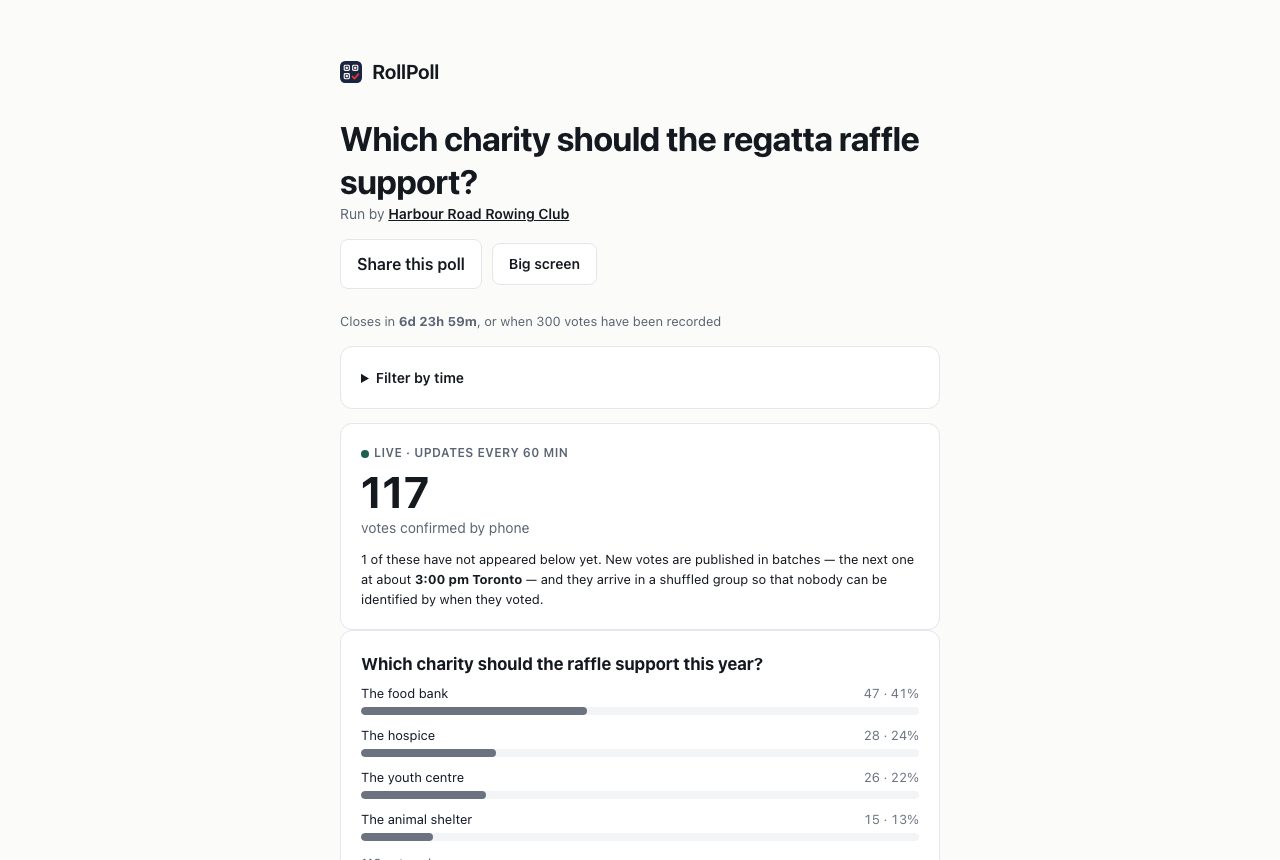
When the poll closes, the count is marked final. If Announce the winner when the poll closes is on, a banner names the winner.
A multiple-choice poll's result
On a Multiple choice question, each bar is how many voters picked that choice, as a share of the voters — not of all the ticks. So the shares can add up to more than 100%, and the page says so: The percentages can add up to more than 100%. Under the bars, 60 voters — each could pick more than one. counts the voters. The top choice is named Most approved, not Winner.
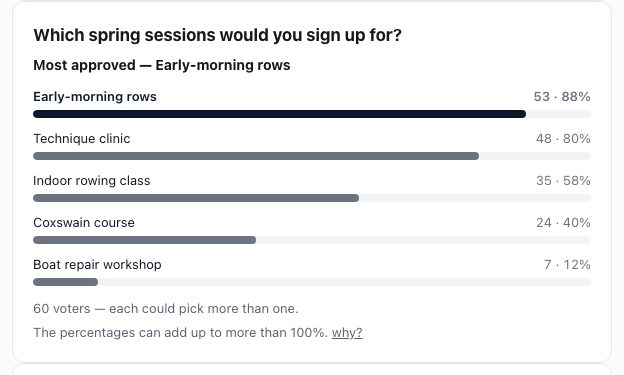
In the record, each voter's picks sit together in one row. Event data (CSV) downloads it, so anyone can count every choice again.
A ranked poll's result
A Ranked question shows no bars while the poll is open: its results page shows only how many votes are in. Its rounds are counted when the poll closes, from the record itself.
In each round, every vote counts for the voter's highest choice still in the running. If one choice has more than half the votes still in play, it wins. If not, the choice in last place drops out — together with any others below it that couldn't catch the next one up — and each of its votes moves to that voter's next choice. A vote whose choices have all dropped out is shown as Ran out of choices.
The page shows Round 1 and every round after it, what went out in each, and where its votes moved. The line above the rounds says how the winner won: Harbour boat cruise won with 21 of the 36 votes still in play.
A tie for last place is settled by how all the voters ranked the tied choices. If even that can't separate them, a draw seeded from the poll's record code decides, and the page says so. Anyone holding the record repeats the same draw.
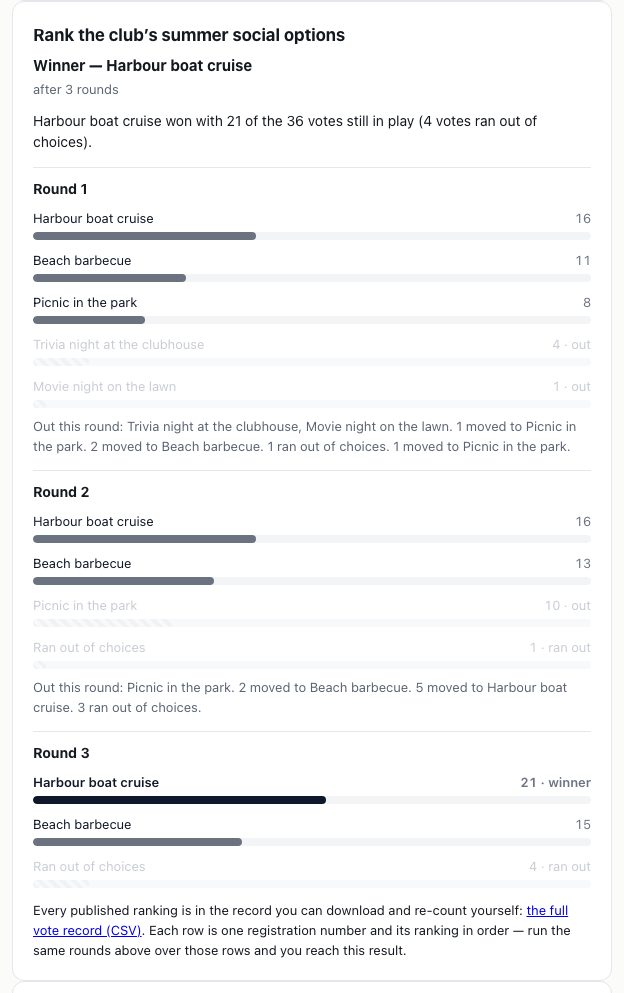
Every voter's ranking is in the record, in order, one row per registration number. the full vote record (CSV) downloads it, so anyone can run the same rounds and reach the same result.
Checking the count
Every voter can check their own vote:
- Find your vote — they type their registration number and press Find my row. The page jumps to their row in Every counted vote.
- The list is in order of registration number, not of when anyone voted — on purpose.
How this poll was run says how many votes were counted, how they were checked, when the poll opened and closed, and the poll's Record code.
The record
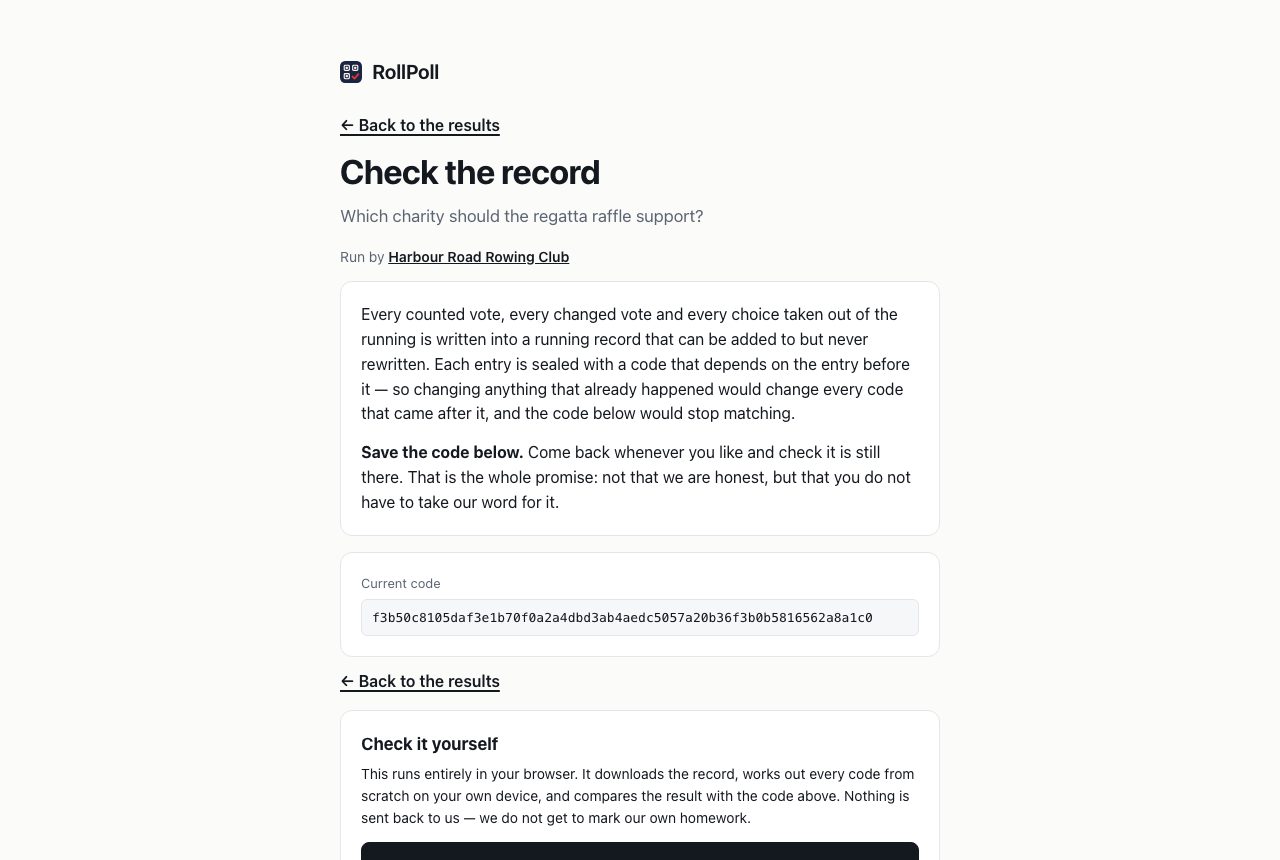
Every vote, every changed vote and every withdrawn choice is written into a record that can be added to but never rewritten. An exit poll's record has no changed votes: its votes are final. Each entry is sealed with a code that depends on the one before it. So changing anything that already happened would change every code after it.
Anyone can press Check the record:
- Current code — save it. Come back later and check it's still there.
- Check this poll’s record — the visitor's own browser downloads the record and works out every code again from scratch. Nothing is sent back to us. On a multiple-choice or ranked poll it checks the record, not each choice or the rounds: its replay counts each voter's picks as one group. To count them again, download the record.
- Every code so far — a code someone saved earlier is in this list if the record they saw then is still inside the record now.
The page says how often the poll releases votes, in the words of its own How often the results update — every 15 minutes, every hour — and shows each vote at its batch's time, not its own.
While a poll's results are hidden — Only people who have voted or Nobody until it closes — each code also mixes in a secret kept with the poll, so an hour with a single vote can't be worked back from its code. The secret opens with the votes: at close it is published on the record page, and the check uses it, so every code can still be worked out again. If a poll set to Nobody until it closes is cancelled before it closes, its votes and its secret are deleted unseen: the record page keeps the times and codes it had already published, says This poll was cancelled before it closed. Its votes were deleted unseen — nobody, the organizer included, ever saw them., and never opens.
Cite & download has the exact record as a file, and a line to cite the poll by.
Scrutineer links
Someone checking the poll for you — a board member, an auditor — can have a scrutineer link. It's private and read-only. It shows the full record, with every vote's exact time and the place it came through. It needs no account.
Under Scrutineer links, choose how long it lasts in Expires in — 24 hours, 3 days or 1 week — and press Create a scrutineer link. Send it to them. You can revoke it at any time.
On a poll set to Nobody until it closes, a scrutineer link shows only Results are sealed until the closing date, with the date, until it closes, and the full record from then on — or, if the poll is cancelled first, This poll was cancelled. Its votes were deleted unseen.
Raw data
Raw data lists every vote, newest first, with what the voter picked and what they answered about themselves. Download votes (CSV) saves it as a file. On a poll set to Nobody until it closes, both open when the poll closes, and never if it is cancelled first.
Visits
Visits shows how many people opened the poll today, in the last 7 days and since it opened, and Where voters give up: how many opened the poll, made a pick, asked for a code, and confirmed. RollPoll counts these itself: no cookies, nothing sent anywhere.
Still stuck? Signed in, use Contact RollPoll. Not signed in, Contact us.